10/21/2013 What qualities does someone have who is intelligent? - - PDF document

10 21 2013
SMART_READER_LITE
LIVE PREVIEW

10/21/2013 What qualities does someone have who is intelligent? - - PDF document

10/21/2013 What qualities does someone have who is intelligent? Intelligence: ability to think rationally, act purposefully, respond to environment Fluid reasoning: similar, impossible Knowledge: how things work, vocab


slide-1
SLIDE 1

10/21/2013 1

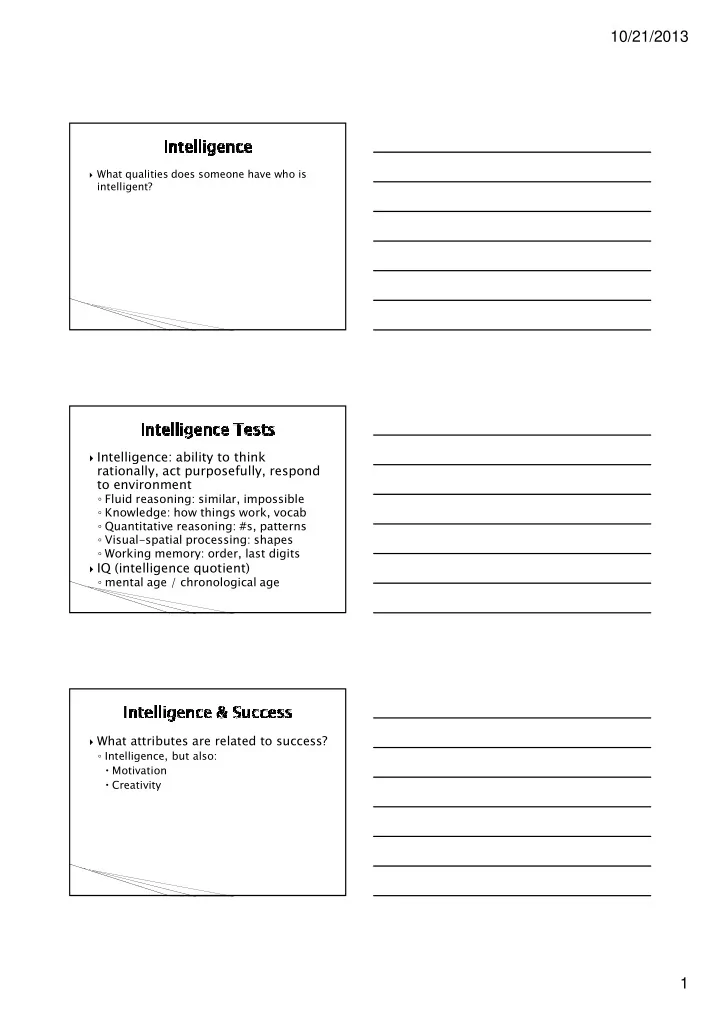
What qualities does someone have who is

intelligent?

Intelligence: ability to think

rationally, act purposefully, respond to environment

  • Fluid reasoning: similar, impossible
  • Knowledge: how things work, vocab
  • Quantitative reasoning: #s, patterns
  • Visual-spatial processing: shapes
  • Working memory: order, last digits

IQ (intelligence quotient)

  • mental age / chronological age

What attributes are related to success?

  • Intelligence, but also:

Motivation Creativity

slide-2
SLIDE 2

10/21/2013 2

Heredity (about 50%)

  • Genes for memory, brain structures,

neuron communication, disorders

Environment

  • Prenatal: nutrition, drugs, stress, sounds
  • Postnatal: nutrition, interaction, practice,

enriched environment, disease, toxins, encouragement/pressure

Adopted Twin Studies – who do we get

intelligence from?

best predictor = person who raised you

  • Thinking: mental representation
  • attention, pattern recognition, memory,

decision-making, intuition, knowledge

  • Images: picture representations
  • Ex. What you were wearing yesterday
  • Ex. (Kinesthetic) remembering dialing
  • Concepts: ideas that represent categories
  • ex. cup, chair, cat
  • Concept formation: classifying by rules
  • Ex. vegetable vs. fruit
  • conjunctive concepts: at least 2 features

(this and that)

  • Ex. rollerskates
  • relational concepts: compared to others
  • Ex. sister
  • disjunctive concepts: at least one
  • Ex. a minority
  • Thinking in concepts takes no effort, is

immediate, and becomes automatic as we age

slide-3
SLIDE 3

10/21/2013 3

  • prototypes: most typical representation
  • Ex. muscle car
  • What kind of music is this?
  • http://www.youtube.com/watch?v=pR30knJs4Xk
  • http://www.youtube.com/watch?v=QZXc39hT8t4&feature=arti

stob&playnext=1&list=TLGBFlP9-ZwiI

  • http://www.youtube.com/watch?v=x0gRzVPMeW0
  • http://www.youtube.com/watch?v=8NhKK8Y-wIo
  • http://www.youtube.com/watch?v=xDprYZ-tgiA
  • http://www.youtube.com/watch?v=x59kS2AOrGM
  • http://www.youtube.com/watch?v=p2Rch6WvPJE&feature=artis

tob&playnext=1&list=TLov2Am8u_lzo

  • http://www.youtube.com/watch?v=Nl4opbNt8_E

Create conceptual rules of classifying music into types & pick a prototype Example: Bluegrass music

  • conjunctive concepts: 2+ features
  • Must have at least a banjo and guitar
  • relational concepts: compared to others
  • More “breakdowns” than country
  • disjunctive concepts: at least one
  • Uses a fiddle or mandolin or harmonica
  • prototypes: most typical representation
  • “Dueling Banjos” http://www.youtube.com/watch?v=l8reNgcIVFU 1:15

Words and symbols used for thinking and communicating

context: situation phonemes: sounds morphemes: syllables grammar: rules for

meaning

syntax: order of words

slide-4
SLIDE 4

10/21/2013 4

Nonverbal gestures

  • En route to language, deaf & hearing
  • Share objects, share info, requests, show emotion

Words

  • Sensitive period: time when learning is done

without effort

9:22-11:24

http://www.youtube.com/watch?v=MSKsID4B VPg&feature=related

What is the difference between language and

communication?

  • Video: Monkey talks

bricks

Solutions

  • Mechanical: trial & error

Reach a banana

  • Understanding: nature of the problem

Hair colorist

  • Heuristics: limit possible solutions

Math – greatest common factor

  • Insight: mental reorganization; sudden

realization

tube http://www.youtube.com/watch?v=ySMh1mBi3cI

slide-5
SLIDE 5

10/21/2013 5

emotional barriers: fear of mistakes

  • speaking up in a group

cultural barriers: values that inhibit creativity

  • culture which values harmony over innovation

learned barriers / functional fixedness:

conventions, meanings, possibilities

  • exfoliator

perceptual barriers: habits, fixed approaches

  • approaching a relationship problem

Creativity

  • Fluency (#)
  • Flexibility (types)
  • Originality (new)

Intuition: quick, emotional response When is intuition inaccurate?

  • Representativeness: fits our idea

accountant

  • Odds

OUR scratcher

  • Emotion

medicine

  • Framing

majority vs. 51%

slide-6
SLIDE 6

10/21/2013 6

How should college admissions be

granted? What kinds of intelligence should be emphasized?