1 What a Game is Not Outline A bunch of cool features What is a - - PDF document

1
SMART_READER_LITE
LIVE PREVIEW

1 What a Game is Not Outline A bunch of cool features What is a - - PDF document

Outline What is a Game? The Game Development Genres Process: Genres What is a Game? (1 of 4) What is a Game? (2 of 4) Movie? Movie? No interaction , outcome fixed Toy? Toy? Puzzle? No goal , but still fun!


slide-1
SLIDE 1

1

The Game Development Process: Genres Outline

What is a Game? Genres

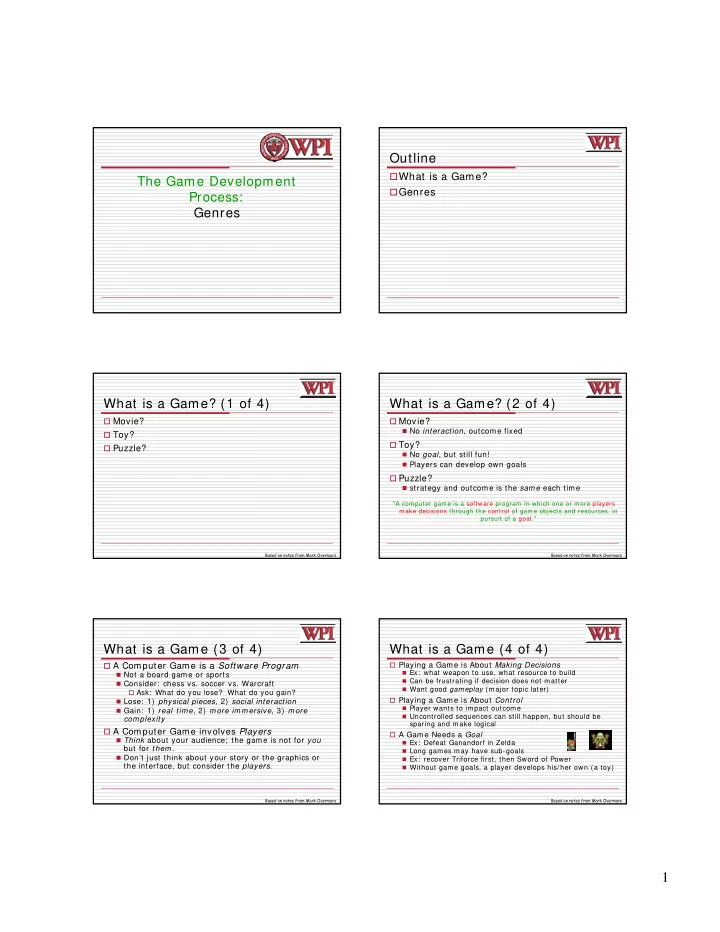
What is a Game? (1 of 4)

 Movie?  Toy?  Puzzle?

Based on notes from Mark Overmars

What is a Game? (2 of 4)

 Movie?

 No interaction, outcome fixed

 Toy?

 No goal, but still fun!  Players can develop own goals  Players can develop own goals

 Puzzle?

 strategy and outcome is the same each time

"A computer game is a software program in which one or more players make decisions through the control of game objects and resources, in pursuit of a goal."

Based on notes from Mark Overmars

What is a Game (3 of 4)

 A Computer Game is a Software Program

 Not a board game or sports  Consider: chess vs. soccer vs. Warcraft  Ask: What do you lose? What do you gain?  Lose: 1) physical pieces, 2) social interaction  Gain: 1) real-time 2) more immersive 3) more  Gain: 1) real time, 2) more immersive, 3) more

complexity  A Computer Game involves Players

 Think about your audience; the game is not for you

but for them.

 Don’t just think about your story or the graphics or

the interface, but consider the players.

Based on notes from Mark Overmars

What is a Game (4 of 4)

 Playing a Game is About Making Decisions

 Ex: what weapon to use, what resource to build  Can be frustrating if decision does not matter  Want good gameplay (major topic later)

 Playing a Game is About Control

 Player wants to impact outcome

y p

 Uncontrolled sequences can still happen, but should be

sparing and make logical  A Game Needs a Goal

 Ex: Defeat Ganandorf in Zelda  Long games may have sub-goals  Ex: recover Triforce first, then Sword of Power  Without game goals, a player develops his/ her own (a toy)

Based on notes from Mark Overmars

slide-2
SLIDE 2

2

What a Game is Not

 A bunch of cool features

 Necessary, but not sufficient  May even detract, if not careful, by concentrating on

features, not game  A lot of fancy graphics

 Games need graphics just as hit movie needs special

effects, but neither will save weak idea

 Game must work without fancy graphics  Suggestion: Should be fun with simple objects

"When a designer is asked how his game is going to make a difference, I hope he … talks about gameplay, fun and creativity – as opposed to an answer that simply focuses on how good it looks." – Sid Meier (Civilizations, Railroad Tycoon, Pirates)

Based on notes from Mark Overmars

Outline

What is a Game? Genres

(next)

Group Game: Game Types!

 Break into groups based on month of birth (or

count off by 5’s… )

 Spread out so can talk without others hearing  Brainstorm all game genres you can think of P id l f h! P id k f !

 Provide an example of each! Provide key feature!

 Round-robin by group, say one genre on list

 What other group has this? Show hands  If no-one else has it, you get a point!  Everyone, decide distinguishing features

 Team with most genres not on anyone else’s

list, wins!

Game Types

What are some types of games? What separates them from others?

Arcade Games

Reaction and speed are the most

important aspects of the game

 Examples: scrolling shooters, maze games

like Pacman, paddle games like Breakout, Pong Pong Relatively easy to make Normally 2D graphics Good starting point for first game Relatively easy in Game Maker

Based on notes from Mark Overmars

Puzzle Games

 Clever thinking is the most important aspect

 Many maze games are based on puzzle solving, rather

than on reaction time  Other examples board games and sliding puzzles  Normally 2 dimensional  Normally 2-dimensional  Relatively easy to create  Except when played against a computer opponent  Artificial Intelligence can be harder

Ex: How to program the computer to play chess?

 Relatively easy in Game Maker

Based on notes from Mark Overmars

slide-3
SLIDE 3

3

Role Playing Games

 Steer a character through a difficult world  Examples are Diablo and Baldur's Gate  Development of character to learn new skills,

becoming more powerful, and finding stuff

 Opponents become more powerful as well  Opponents become more powerful as well  Can create 2D or 3D  Generally harder to make because must create

the mechanism of character development

 Also normally need large world  Good level design is crucial  Difficult in Game Maker

Based on notes from Mark Overmars

Strategy Games

 Real-time (RTS) or turn-based  Player only indirectly controls the character  Tactics less important than Strategy  Examples include Age of Empires, Warcraft III…  Also, usually "God Games", such as Black & White  Generally take a lot of time to create  Require many different game objects, each with animated images and specific behavior

 Difficult in Game Maker

Based on notes from Mark Overmars

Adventure Games

Game is about adventure and exploration

 Story line is often crucial

Can be 2D or 3D Actions easy (just move) Difficulty is in making

exploration/ adventure interesting

 Interesting, funny, and surprising story line  Corresponding artwork

Artists’ role is crucial Somewhat difficult in Game Maker

Based on notes from Mark Overmars

First-Person Shooters

3D version of many arcade-style games

(move and shoot)

Emphasis is on fast-paced action and

reaction speed, not on cleverness and l l i puzzle solving

Many examples: Doom, Quake, … Need to be 3D Relatively difficult to create because of

models

Difficult in Game Maker

Based on notes from Mark Overmars

Third-Person Action/ Platformer

 Player directly controls a game character (avatar)

through a hostile world

 Tomb Raider, Prince of Persia, Onimusha  Often, not much emphasis on character

development development

 Fast action and discovering the game world  Some have story line, other adventure game

aspects

 Can be 2D or 3D  Can sometimes be created easily  Moderately easy in Game Maker

Based on notes from Mark Overmars

Sports Games

Real-life sport, made virtual Ideas, rules in place Making realistic, challenging, fun like

sport can be difficult sport can be difficult

If not realisitc, can be done in Game

Maker

Based on notes from Mark Overmars

slide-4
SLIDE 4

4

Racing Games

Really, special type of sports game

 But pervasive enough to get own category

Drive a vehicle, as fast as possible, or

sometimes for exploration, or combat

Either realistic...

 Formula 1 or Grand Tourismo

...or focused on fun (arcade)

 Midtown Madness or Ridge Racer

Both 2D or 3D Difficult in Game Maker

Based on notes from Mark Overmars

Simulators

Try for realistic representation

 Ex: flight simulators, Trainz

Other simulations include world

simulation

 Ex: SimCity or SimEarth

Relatively difficult to create since getting

details right a challenge

Difficult in Game Maker

Based on notes from Mark Overmars

Party Games

Variety of types

 Ex: Mario Party, DDR, Karaoke, Guitar Hero

Social aspects important with

participants in the same space p p p

Allow for rapid change of turns Allow for disparate abilities (beginners

and experts, both have fun)

Easy in Game Maker

Educational Games

Entertainment games are great at

teaching… how to play the game!

Educational games are designed to teach

player knowledge or skill that is valuable player knowledge or skill that is valuable

  • utside the game

 Ex: math, reading, problem solving

Relatively difficult in Game Maker (unless

you have the domain expertise)