1 3. Simple Memory System Cache Address Translation Example #1 16 - - PDF document

1
SMART_READER_LITE
LIVE PREVIEW

1 3. Simple Memory System Cache Address Translation Example #1 16 - - PDF document

Today Simple memory system example Case study: Core i7/Linux memory system Virtual Memory: Systems Memory mapping CSci 2021: Machine Architecture and Organization April 20th-22nd, 2020 Your instructor: Stephen McCamant Based on


slide-1
SLIDE 1

1

1 Bryant and O’Hallaron, Computer Systems: A Programmer’s Perspective, Third Edition

Virtual Memory: Systems

CSci 2021: Machine Architecture and Organization April 20th-22nd, 2020 Your instructor: Stephen McCamant Based on slides originally by: Randy Bryant, Dave O’Hallaron

2 Bryant and O’Hallaron, Computer Systems: A Programmer’s Perspective, Third Edition

Today

 Simple memory system example  Case study: Core i7/Linux memory system  Memory mapping

3 Bryant and O’Hallaron, Computer Systems: A Programmer’s Perspective, Third Edition

Review of Symbols

 Basic Parameters

  • N = 2n : Number of addresses in virtual address space
  • M = 2m : Number of addresses in physical address space
  • P = 2p : Page size (bytes)

 Components of the virtual address (VA)

  • TLBI: TLB index
  • TLBT: TLB tag
  • VPO: Virtual page offset
  • VPN: Virtual page number

 Components of the physical address (PA)

  • PPO: Physical page offset (same as VPO)
  • PPN: Physical page number
  • CO: Byte offset within cache line
  • CI: Cache index
  • CT: Cache tag

4 Bryant and O’Hallaron, Computer Systems: A Programmer’s Perspective, Third Edition

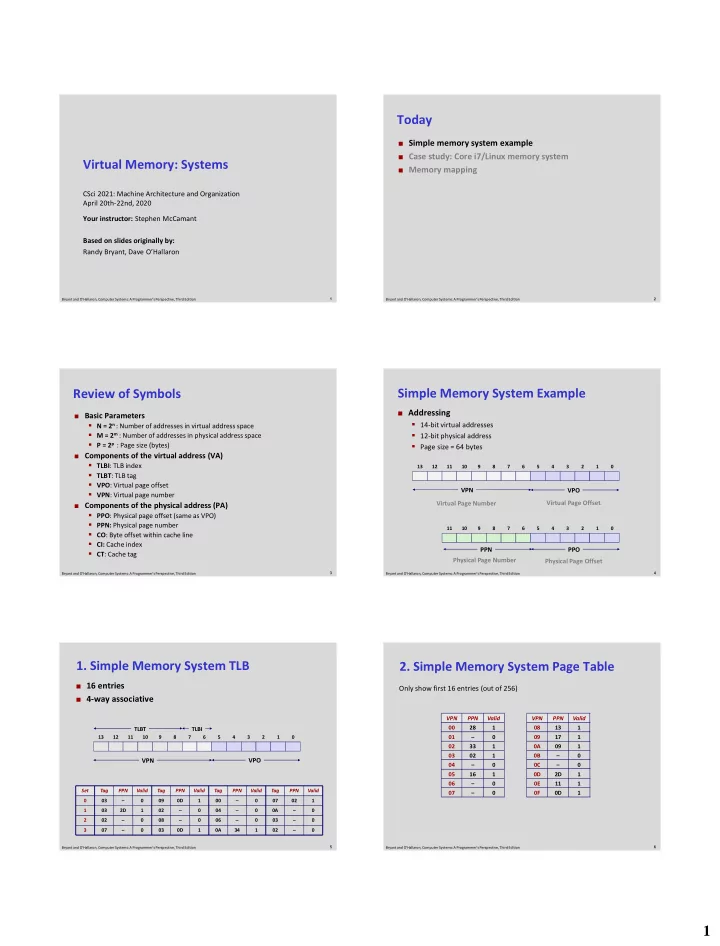
Simple Memory System Example

 Addressing

  • 14-bit virtual addresses
  • 12-bit physical address
  • Page size = 64 bytes

13 12 11 10 9 8 7 6 5 4 3 2 1 11 10 9 8 7 6 5 4 3 2 1

VPO PPO PPN VPN Virtual Page Number Virtual Page Offset Physical Page Number Physical Page Offset

5 Bryant and O’Hallaron, Computer Systems: A Programmer’s Perspective, Third Edition

  • 1. Simple Memory System TLB

 16 entries  4-way associative 13 12 11 10 9 8 7 6 5 4 3 2 1

VPO VPN

TLBI TLBT

– 02 1 34 0A 1 0D 03 – 07 3 – 03 – 06 – 08 – 02 2 – 0A – 04 – 02 1 2D 03 1 1 02 07 – 00 1 0D 09 – 03 Valid PPN Tag Valid PPN Tag Valid PPN Tag Valid PPN Tag Set

6 Bryant and O’Hallaron, Computer Systems: A Programmer’s Perspective, Third Edition

  • 2. Simple Memory System Page Table

Only show first 16 entries (out of 256)

1 0D 0F 1 11 0E 1 2D 0D – 0C – 0B 1 09 0A 1 17 09 1 13 08 Valid PPN VPN – 07 – 06 1 16 05 – 04 1 02 03 1 33 02 – 01 1 28 00 Valid PPN VPN

slide-2
SLIDE 2

2

7 Bryant and O’Hallaron, Computer Systems: A Programmer’s Perspective, Third Edition

  • 3. Simple Memory System Cache

 16 lines, 4-byte block size  Physically addressed  Direct mapped 11 10 9 8 7 6 5 4 3 2 1

PPO PPN

CO CI CT

03 DF C2 11 1 16 7 – – – – 31 6 1D F0 72 36 1 0D 5 09 8F 6D 43 1 32 4 – – – – 36 3 08 04 02 00 1 1B 2 – – – – 15 1 11 23 11 99 1 19 B3 B2 B1 B0 Valid Tag Idx – – – – 14 F D3 1B 77 83 1 13 E 15 34 96 04 1 16 D – – – – 12 C – – – – 0B B 3B DA 15 93 1 2D A – – – – 2D 9 89 51 00 3A 1 24 8 B3 B2 B1 B0 Valid Tag Idx

8 Bryant and O’Hallaron, Computer Systems: A Programmer’s Perspective, Third Edition

Address Translation Example #1

Virtual Address: 0x03D4

VPN ___ TLBI ___ TLBT ____ TLB Hit? __ Page Fault? __ PPN: ____

Physical Address

CO ___ CI___ CT ____ Hit? __ Byte: ____

13 12 11 10 9 8 7 6 5 4 3 2 1

VPO VPN

TLBI TLBT

11 10 9 8 7 6 5 4 3 2 1

PPO PPN

CO CI CT

1 1 1 1 1 1

0x0F 0x3 0x03 Y N 0x0D

1 1 1 1 1

0x5 0x0D Y 0x36

9 Bryant and O’Hallaron, Computer Systems: A Programmer’s Perspective, Third Edition

Address Translation Example #2

Virtual Address: 0x0020

VPN ___ TLBI ___ TLBT ____ TLB Hit? __ Page Fault? __ PPN: ____

Physical Address

CO___ CI___ CT ____ Hit? __ Byte: ____

13 12 11 10 9 8 7 6 5 4 3 2 1

VPO VPN

TLBI TLBT

11 10 9 8 7 6 5 4 3 2 1

PPO PPN

CO CI CT

1

0x00 0x00 N N 0x28

1 1 1

0x8 0x28 N Mem

11 Bryant and O’Hallaron, Computer Systems: A Programmer’s Perspective, Third Edition

Today

 Simple memory system example  Case study: Core i7/Linux memory system  Memory mapping

12 Bryant and O’Hallaron, Computer Systems: A Programmer’s Perspective, Third Edition

Intel Core i7 Memory System

L1 d-cache 32 KB, 8-way L2 unified cache 256 KB, 8-way L3 unified cache 8 MB, 16-way (shared by all cores) Main memory Registers L1 d-TLB 64 entries, 4-way L1 i-TLB 128 entries, 4-way L2 unified TLB 512 entries, 4-way L1 i-cache 32 KB, 8-way MMU (addr translation) Instruction fetch Core x4 DDR3 Memory controller 3 x 64 bit @ 10.66 GB/s 32 GB/s total (shared by all cores) Processor package QuickPath interconnect 4 links @ 25.6 GB/s each To other cores To I/O bridge

13 Bryant and O’Hallaron, Computer Systems: A Programmer’s Perspective, Third Edition

Review of Symbols

 Basic Parameters

  • N = 2n : Number of addresses in virtual address space
  • M = 2m : Number of addresses in physical address space
  • P = 2p : Page size (bytes)

 Components of the virtual address (VA)

  • TLBI: TLB index
  • TLBT: TLB tag
  • VPO: Virtual page offset
  • VPN: Virtual page number

 Components of the physical address (PA)

  • PPO: Physical page offset (same as VPO)
  • PPN: Physical page number
  • CO: Byte offset within cache line
  • CI: Cache index
  • CT: Cache tag
slide-3
SLIDE 3

3

14 Bryant and O’Hallaron, Computer Systems: A Programmer’s Perspective, Third Edition

End-to-end Core i7 Address Translation

CPU VPN VPO

36 12

TLBT TLBI

4 32

... L1 TLB (16 sets, 4 entries/set)

VPN1 VPN2

9 9

PTE

CR3 PPN PPO

40 12

Page tables TLB miss TLB hit Physical address (PA) Result

32/64

... CT CO

40 6

CI

6

L2, L3, and main memory L1 d-cache (64 sets, 8 lines/set) L1 hit L1 miss Virtual address (VA)

VPN3 VPN4

9 9

PTE PTE PTE

15 Bryant and O’Hallaron, Computer Systems: A Programmer’s Perspective, Third Edition

Core i7 Level 1-3 Page Table Entries

Page table physical base address Unused G PS A CD WT U/S R/W P=1

Each entry references a 4K child page table. Significant fields:

P: Child page table present in physical memory (1) or not (0). R/W: Read-only or read-write access access permission for all reachable pages. U/S: user or supervisor (kernel) mode access permission for all reachable pages. WT: Write-through or write-back cache policy for the child page table. A: Reference bit (set by MMU on reads and writes, cleared by software). PS: Page size either 4 KB or 4 MB (defined for Level 1 PTEs only). Page table physical base address: 40 most significant bits of physical page table address (forces page tables to be 4KB aligned) XD: Disable or enable instruction fetches from all pages reachable from this PTE.

51 12 11 9 8 7 6 5 4 3 2 1 Unused XD Available for OS (page table location on disk) P=0 52 62 63

16 Bryant and O’Hallaron, Computer Systems: A Programmer’s Perspective, Third Edition

Core i7 Level 4 Page Table Entries

Page physical base address Unused G D A CD WT U/S R/W P=1

Each entry references a 4K child page. Significant fields:

P: Child page is present in memory (1) or not (0) R/W: Read-only or read-write access permission for child page U/S: User or supervisor mode access WT: Write-through or write-back cache policy for this page A: Reference bit (set by MMU on reads and writes, cleared by software) D: Dirty bit (set by MMU on writes, cleared by software) Page physical base address: 40 most significant bits of physical page address (forces pages to be 4KB aligned) XD: Disable or enable instruction fetches from this page.

51 12 11 9 8 7 6 5 4 3 2 1 Unused XD Available for OS (page location on disk) P=0 52 62 63

17 Bryant and O’Hallaron, Computer Systems: A Programmer’s Perspective, Third Edition

Core i7 Page Table Translation

CR3 Physical address

  • f page

Physical address

  • f L1 PT

9

VPO

9 12

Virtual address

L4 PT Page table L4 PTE PPN PPO

40 12

Physical address

Offset into physical and virtual page VPN 3 VPN 4 VPN 2 VPN 1 L3 PT Page middle directory L3 PTE L2 PT Page upper directory L2 PTE L1 PT Page global directory L1 PTE

9 9 40 / 40 / 40 / 40 / 40 / 12 /

512 GB region per entry 1 GB region per entry 2 MB region per entry 4 KB region per entry

18 Bryant and O’Hallaron, Computer Systems: A Programmer’s Perspective, Third Edition

Cute Trick for Speeding Up L1 Access

 Observation

  • Bits that determine CI identical in virtual and physical address
  • Can index into cache while address translation taking place
  • Generally we hit in TLB, so PPN bits (CT bits) available next
  • “Virtually indexed, physically tagged”
  • Cache carefully sized to make this possible

Physical address (PA)

CT CO 40 6 CI 6

Virtual address (VA)

VPN VPO 36 12 PPO PPN

Address Translation

No Change CI

L1 Cache

CT

Tag Check

19 Bryant and O’Hallaron, Computer Systems: A Programmer’s Perspective, Third Edition

Virtual Address Space of a Linux Process

Kernel code and data Memory mapped region for shared libraries Runtime heap (malloc) Program text (.text) Initialized data (.data) Uninitialized data (.bss) User stack

%rsp

Process virtual memory brk

Physical memory

Identical for each process

Process-specific data structs (ptables, task and mm structs, kernel stack)

Kernel virtual memory

0x00400000

Different for each process

slide-4
SLIDE 4

4

20 Bryant and O’Hallaron, Computer Systems: A Programmer’s Perspective, Third Edition

vm_next vm_next

Linux Organizes VM as Collection of “Areas”

task_struct mm_struct pgd mm mmap vm_area_struct vm_end vm_prot vm_start vm_end vm_prot vm_start vm_end vm_prot vm_next vm_start Process virtual memory Text Data Shared libraries

 pgd:

  • Page global directory address
  • Points to L1 page table

 vm_prot:

  • Read/write permissions for

this area

 vm_flags

  • Pages shared with other

processes or private to this process vm_flags vm_flags vm_flags

21 Bryant and O’Hallaron, Computer Systems: A Programmer’s Perspective, Third Edition

Linux Page Fault Handling

read 1 write 2 read 3 vm_next vm_next vm_area_struct vm_end vm_prot vm_start vm_end vm_prot vm_start vm_end vm_prot vm_next vm_start Process virtual memory text data shared libraries vm_flags vm_flags vm_flags

Segmentation fault: accessing a non-existing page Normal page fault Protection exception: e.g., violating permission by writing to a read-only page (Linux reports as Segmentation fault)

22 Bryant and O’Hallaron, Computer Systems: A Programmer’s Perspective, Third Edition

Today

 Simple memory system example  Case study: Core i7/Linux memory system  Memory mapping

23 Bryant and O’Hallaron, Computer Systems: A Programmer’s Perspective, Third Edition

Memory Mapping

 VM areas initialized by associating them with disk objects.

  • Process is known as memory mapping.

 Area can be backed by (i.e., get its initial values from) :

  • Regular file on disk (e.g., an executable object file)
  • Initial page bytes come from a section of a file
  • Anonymous file (e.g., nothing)
  • First fault will allocate a physical page full of 0's (demand-zero page)
  • Once the page is written to (dirtied), it is like any other page

 Dirty pages are copied back and forth between memory and a

special swap file (or partition).

24 Bryant and O’Hallaron, Computer Systems: A Programmer’s Perspective, Third Edition

Sharing Revisited: Shared Objects

 Process 1 maps

the shared

  • bject.

Shared

  • bject

Physical memory Process 1 virtual memory Process 2 virtual memory

25 Bryant and O’Hallaron, Computer Systems: A Programmer’s Perspective, Third Edition

Sharing Revisited: Shared Objects

Shared

  • bject

Physical memory Process 1 virtual memory Process 2 virtual memory

 Process 2 maps

the shared

  • bject.

 Notice how the

virtual addresses can be different.

slide-5
SLIDE 5

5

26 Bryant and O’Hallaron, Computer Systems: A Programmer’s Perspective, Third Edition

Sharing Revisited: Private Copy-on-write (COW) Objects

 Two processes

mapping a private copy-on-write (COW) object.

 Area flagged as

private copy-on- write

 PTEs in private

areas are flagged as read-only

Private copy-on-write object Physical memory Process 1 virtual memory Process 2 virtual memory Private copy-on-write area

27 Bryant and O’Hallaron, Computer Systems: A Programmer’s Perspective, Third Edition

Sharing Revisited: Private Copy-on-write (COW) Objects

 Instruction writing

to private page triggers protection fault.

 Handler creates

new R/W page.

 Instruction

restarts upon handler return.

 Copying deferred

as long as possible!

Private copy-on-write object Physical memory Process 1 virtual memory Process 2 virtual memory

Copy-on-write

Write to private copy-on-write page

30 Bryant and O’Hallaron, Computer Systems: A Programmer’s Perspective, Third Edition

User-Level Memory Mapping

void *mmap(void *start, int len, int prot, int flags, int fd, int offset)

 Map len bytes starting at offset offset of the file specified

by file description fd, preferably at address start

  • start: may be 0 for “pick an address”
  • prot: PROT_READ, PROT_WRITE, ...
  • flags: MAP_ANON, MAP_PRIVATE, MAP_SHARED, ...

 Return a pointer to start of mapped area (may not be start)

31 Bryant and O’Hallaron, Computer Systems: A Programmer’s Perspective, Third Edition

User-Level Memory Mapping

void *mmap(void *start, int len, int prot, int flags, int fd, int offset)

len bytes start

(or address chosen by kernel)

Process virtual memory Disk file specified by file descriptor fd len bytes

  • ffset

(bytes)

32 Bryant and O’Hallaron, Computer Systems: A Programmer’s Perspective, Third Edition

Example: Using mmap to Copy Files

/* mmapcopy driver */ int main(int argc, char **argv) { struct stat stat; int fd; /* Check for required cmd line arg */ if (argc != 2) { printf("usage: %s <filename>\n", argv[0]); exit(0); } /* Copy input file to stdout */ fd = open(argv[1], O_RDONLY, 0); fstat(fd, &stat); mmapcopy(fd, stat.st_size); exit(0); }  Copying a file to stdout without transferring data through

  • ther program memory.

#include "csapp.h" void mmapcopy(int fd, int size) { /* Ptr to memory mapped area */ char *bufp; bufp = mmap(NULL, size, PROT_READ, MAP_PRIVATE, fd, 0); write(1, bufp, size); return; }

mmapcopy.c mmapcopy.c