1 Source port Destination port Source port Destination port 32 - - PDF document

1
SMART_READER_LITE
LIVE PREVIEW

1 Source port Destination port Source port Destination port 32 - - PDF document

A MUCH more complex complex transport transport A MUCH more Lecture 6. Lecture 6. for for three three main main reasons reasons Connection oriented Internet Transport Layer: Internet Transport Layer: implements mechanisms to


slide-1
SLIDE 1

1

Giuseppe Bianchi

Lecture 6. Lecture 6.

Internet Transport Layer: Internet Transport Layer: introduction to the introduction to the

Transport Control Protocol Transport Control Protocol (TCP) (TCP)

RFC 793 RFC 793 ( (estensioni estensioni RFC 1122,1323,2018,2581,working group RFC 1122,1323,2018,2581,working group tsvwg tsvwg) ) Giuseppe Bianchi

A MUCH more A MUCH more complex complex transport transport

for for three three main main reasons reasons

Connection oriented

implements mechanisms to setup and tear down a full duplex connection between end points

Reliable

implements mechanisms to guarantee error free and ordered delivery of information

Flow & Congestion controlled

implements mechanisms to control traffic

Giuseppe Bianchi

TCP services TCP services

connection oriented TCP connections reliable transfer service all bytes sent are received

IP IP IP IP TCP TCP IP Appl. Appl.

TCP functions

application addressing (ports) error recovery (acks and retransmission) reordering (sequence numbers) flow control congestion control

Giuseppe Bianchi

Byte Byte stream stream service service

TCP exchange data between applications as a stream of bytes It does not introduce any data delimiter (an application duty)

source application may enter 10 bytes followed by 1 and 40 (grouped with some semantics) data is buffered at source, and transmitted at receiver, may be read in the sequence 25 bytes, 22 bytes and 4 bytes... Application view TCP view

Giuseppe Bianchi

TCP TCP segments segments

Application data broken into segments for transmission segmentation totally up to TCP, according to what TCP considers being the best strategy each segment placed into an IP packet very different from UDP!!

TCP data IP data Header IP Header TCP TCP data IP data Header IP Header TCP

Giuseppe Bianchi

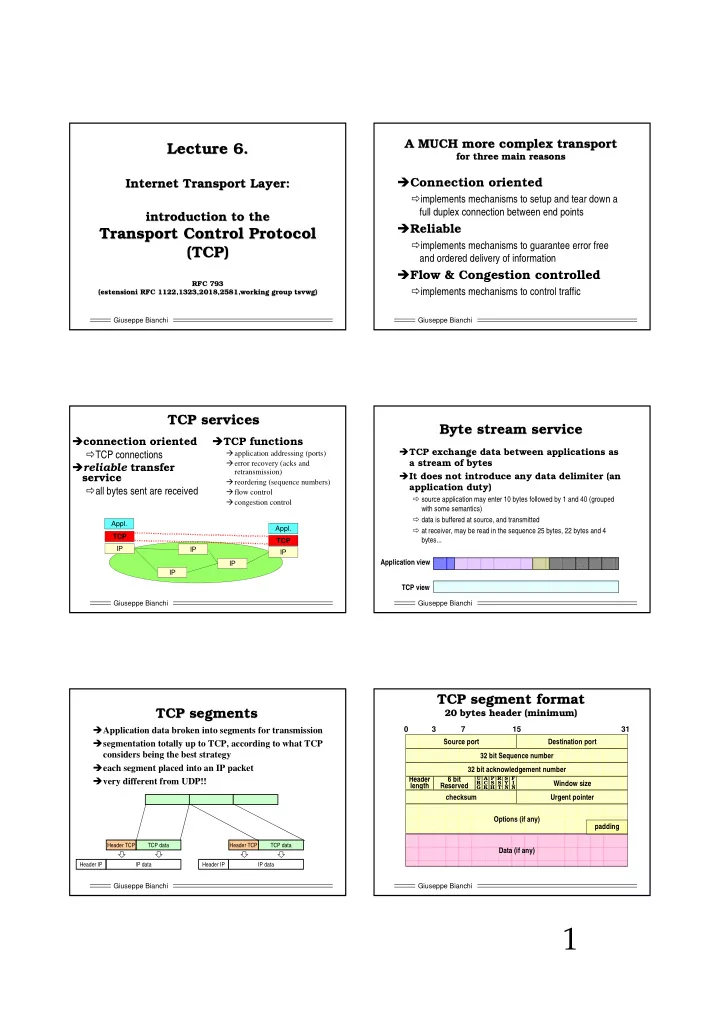
TCP TCP segment segment format format

20 20 bytes bytes header header (minimum) (minimum)

3 7 15 31 Header length checksum 32 bit Sequence number Window size Source port Destination port Options (if any) 32 bit acknowledgement number 6 bit Reserved Urgent pointer Data (if any) padding

U R G A C K P S H R S T S Y N F I N

slide-2
SLIDE 2

2

Giuseppe Bianchi

Source & destination port + source and destination IP addresses univocally determine TCP connection checksum as in UDP same calculation including same pseudoheader no explicit segment length specification

Header length checksum 32 bit Sequence number Window size Source port Destination port 32 bit acknowledgement number 6 bit Reserved Urgent pointer

U R G A C K P S H R S T S Y N F I N

Giuseppe Bianchi

Header length: 4 bits specifies the header size (n*4byte words) for options maximum header size: 60 (15*4)

  • ption field size must be multiple of 32bits: zero padding

when not. Reserved: 000000 (still today!)

Header length checksum 32 bit Sequence number Window size Source port Destination port 32 bit acknowledgement number 6 bit Reserved Urgent pointer

U R G A C K P S H R S T S Y N F I N

Options (if any) 00000000

Giuseppe Bianchi

Reliable Reliable data transfer: data transfer: issues issues

mechanisms to guarantee correct reception: Forward Error Correction (FEC) coding schemes

Powerful to correct bits affected by error, less effective in case of packet loss Mostly used at link layer

Retransmission – issues:

ACK NACK TIMEOUT

INTERNET

packet packet PROBLEMS:

1) Packet received with errors 2) Packet not received at all

Same problem considered at DATA LINK LAYER (although it is less likely that a whole packet is lost at data link)

Giuseppe Bianchi

Retransmission Retransmission scenarios scenarios

referred referred to to as as ARQ ARQ schemes schemes ( (A Automatic utomatic R Repeat epeat re reQ Quest uest) )

DATA A C K

SRC DST Basic ACK idea

DATA N A C K

SRC DST Basic NACK idea

Error Check: OK

COMPONENTS: a) error checking at receiver; b) feedback to sender; c) retx

Error Check: corrupted

DATA

Automatic retransmit

DATA

SRC DST Basic ACK/Timeout idea

Retx Timeout (RTO)

DATA DATA

SRC DST

DATA

Error Check: corrupted

DATA

SRC DST

DATA A C K Giuseppe Bianchi

Why Why sequence sequence numbers numbers? ?

(on data) (on data)

Sender side:

DATA DATA A C K

RTO

DATA

rtx Receiver side:

DATA

NETWORK (ACK lost) New data? Old data? Need to univocally “label” all packets circulating in the network between two end points. 1 bit (0-1) enough for Stop-and-wait

Giuseppe Bianchi

Why Why sequence sequence numbers numbers? ?

(on (on ack ack) )

Sender side:

DATA 1 DATA 2

Receiver side: Data 2 lost !! With pathologically critical network (as the Internet!) also need to univocally “label” all acks circulating in the network between two end points. 1 bit (0-1) enough for Stop-and-wait

A C K

Queueing Delay Duplicated ACK

DATA 3 A C K

slide-3
SLIDE 3

3

Giuseppe Bianchi

Sequence number: Sequence number of the first byte in the segment. When reaches 232-1, next wraps back to 0 Acknowledgement number: valid only when ACK flag on Contains the next byte sequence number that the host expects to receive (= last successfully received byte of data + 1) grants successful reception for all bytes up to ack# - 1 (cumulative) When seq/ack reach 232-1, next wrap back to 0

Header length checksum 32 bit Sequence number Window size Source port Destination port 32 bit acknowledgement number 6 bit Reserved Urgent pointer

U R G A C K P S H R S T S Y N F I N

Giuseppe Bianchi

TCP data transfer management TCP data transfer management

Full duplex connection

data flows in both directions, independently To the application program these appear as two unrelated data streams Impossible to build multicast connection

each end point maintains a sequence number

Independent sequence numbers at both ends Measured in bytes

acks often carried on top of reverse flow data segments (piggybacking)

But ack packets alone are possible

Giuseppe Bianchi

Byte Byte-

  • oriented
  • riented

100 1 … … 535 … … 1023 … … Example: 1 kbyte message – 1024 bytes … Example: segment size = 536 bytes 2 segments: 0-535; 536-1023 seq=0 Ack=536 seq=536 Ack=1024 time time sender receiver

  • Giuseppe Bianchi

Pipelining Pipelining

100 1 … … 535 … … 1023 … … Example: 1024 bytes msg; seg_size = 536 bytes 2 segments: 0-535; 536-1023 … seq=0 seq=536 Ack=1024 time time sender receiver sliding window mechanisms Go-Back-N and Selective Repeat Why pipelining? Dramatic improvement in efficiency! Ack=536

Giuseppe Bianchi

Cumulative ack Cumulative ack

100 1 … … 535 … … 1023 … … Example: 1024 bytes msg; seg_size = 536 bytes 2 segments: 0-535; 536-1023 … seq=0 seq=536 Ack=1024 time time sender receiver

  • !"

E.g. ACK=1024: all bytes 0-1023 received Go-Back-N ARQ mechanisms Sliding window mechanisms Why pipelining? Dramatic improvement in efficiency!

Giuseppe Bianchi

Multiple Multiple acks acks; ; Piggybacking Piggybacking

CLIENT SERVER Bytes 100-199, seq=100, EMPTY, Ack=200 Bytes 450-525, seq=450, ack=200 Bytes 200-249, seq=200, ack=526 Immediate ack, no payload Data in reverse direction,carries previous ack Next segment, piggybacked ack

slide-4
SLIDE 4

4

Giuseppe Bianchi

TCP data transfer TCP data transfer bidirectional bidirectional example example

16 15 14 13 12 11 10 9 8 7 6 5 4 3 2 1 118 117 116 115 114 113 112 Segment size = 6 Segment size = 4

Time 0:

Seq=1, NO ack Seq=112, NO ack

Time 1:

Seq=7, ack=116 Seq=116, ack=7

Time 2:

Seq=13, ack=119 Seq=119, ack=13

Time 3:

Seq=119, ack=17

Giuseppe Bianchi

Performance issues with/without pipelining

Giuseppe Bianchi

Tx delay B/C

Link Link delay delay computation computation

Router

# !$ C [bit/s] = link rate B [bit] = packet size transmission delay = B/C [sec] %&$ 512 bytes packet 64 kbps link transmission delay = 512*8/64000 = 64ms ' !( !! Link length Electromagnetig waves propagation speed in considered media 200 km/s for copper links 300 km/s in air ) *$ *!! queueing processing time sender time receiver

Tx delay B/C Prop delay

Giuseppe Bianchi

Stop Stop-

  • and

and-

  • wait

wait performance performance

Router 1 Router 2

28.8 Kbps 1 ms 1024 Kbps 30 ms 28.8 Kbps 1 ms

time time Start tx …………… Completion time =

Tx1 + Prop1 + Tx2 + Prop2 + Tx3 + Prop3 + Ack_Tx1 + Prop1 + Ack_Tx2 + Prop2 + Ack_Tx3 + Prop3 + [same computation for other segments]=

= RTT + Tx1 + Tx2 + Tx3 + Ack_Tx1 + Ack_Tx2 + Ack_Tx3 +...

tx1 prop1 prop2 tx2 prop3 tx3

Giuseppe Bianchi Router 1 Router 2

28.8 Kbps 1 ms 1024 Kbps 30 ms 28.8 Kbps 1 ms

Stop Stop-

  • and

and-

  • wait

wait performance performance

Numerical Numerical example example

Message:

1024 bytes; 2 segments: 536+488 bytes Overhead: 20 bytes TCP + 20 bytes IP ACK = 40 bytes (header only)

Segment 1:

Tx1 = 576*8/28,8 = 160ms Tx3 = Tx1 Tx2 = 576*8/1024 = 4,5 ms

Segment 2:

Tx1 = 528*8/28,8 = 146,7ms Tx3 = Tx1 Tx2 = 528*8/1024 = 4,1 ms

Acks:

Tx1 = Tx3 = 40*8/28,8 = 11,1ms Tx2 = 40*8/1024 = 0,3 ms

RESULT: D = 667 (tx total) + 2*RTT = = 795 ms THR = 1024*8/795 = = 10,3 kbps

Giuseppe Bianchi Router 1 Router 2

128 Kbps 1 ms 1024 Kbps 30 ms 128 Kbps 1 ms

Stop Stop-

  • and

and-

  • wait

wait performance performance

Numerical Numerical example example

Segment 1:

Tx1 = Tx3 = 576*8/128 = 36ms Tx2 = 576*8/1024 = 4,5 ms

Segment 2:

Tx1 = Tx3 = 528*8/128 = 33 ms Tx2 = 528*8/1024 = 4,1 ms

Acks:

Tx1 = Tx3 = 40*8/128 = 2,5 ms Tx2 = 40*8/1024 = 0,3 ms

RESULT: D = 157,2 (tx total) + 2*RTT = = 279,9 ms THR = 1024*8/279,9 = = 29,3 kbps With ISDN?

  • n Gbps fiber optics?

D = negligible + 2*RTT = = 128 ms THR = 1024*8/128 = = 64 kbps

slide-5
SLIDE 5

5

Giuseppe Bianchi

Pipelining Pipelining performance performance

Router 1 Router 2

256 Kbps 1 ms 1024 Kbps 30 ms 256 Kbps 1 ms

time time time time Start tx …………… full tx time Completion time (neglecting processing & queueing) =

Tx1 + Prop1 + Tx2 + Prop2 + Tx3 + Prop3 + Tx_bottleneck Ack_Tx1 + Prop1 + Ack_Tx2 + Prop2 + Ack_Tx3 + Prop3 (that’s it!)

tx1 prop1 prop2 tx2 prop3 tx3

Giuseppe Bianchi

Pipelining Pipelining performance performance

numerical numerical example example

On 28,8 kbps links D = 347 (tx segm1+ack) + RTT + + 160 (segm2 bottleneck) = = 571 ms THR = 1024*8/571 = = 14,3 kbps On 128 kbps ISDN links D = 81,8 (tx segm1+ack) + RTT + + 33 (segm2 bottleneck) = = 178,8 ms THR = 1024*8/178,8 = = 45,8 kbps

  • n Gbps fiber optics?

D = negligible + RTT = 64 ms THR = 1024*8/64 = 128 kbps

Giuseppe Bianchi

Simplified Simplified performance model performance model

C bits/sec Approximate analysis, much simpler than multi-hop Typically, C = bottleneck link rate MSS = segment size MSIZE = message size Ignore overhead Ignore ACK transmission time No loss of segments W = number of outstanding segments W=1: stop-and-wait W>1: sliding window This is a highly dynamic parameter in TCP!! For now, consider W fixed

Giuseppe Bianchi

W=1 case ( W=1 case (stop stop-

  • and

and-

  • wait

wait) )

time sender time receiver One way delay RTT

C MSS RTT MSS throughput / + =

MSS/C REMARK: throughput always lower than Available link rate!

Giuseppe Bianchi

Latency Latency in TCP in TCP retrieval retrieval model model

time client time server

RTT MSS MSIZE C MSIZE RTT latency

+ + = 1 2

Latency: time elapsing between TCP connection Request, and last bit received at client Number of segments In which message is split

Start TCP connection request

  • bject

RTT RTT

Giuseppe Bianchi

W=1 case ( W=1 case (stop stop-

  • and

and-

  • wait

wait) )

MSS = 1500 MSS = 1500 bytes bytes throughput 10 100 1000 10000 1 10 100 1000 RTT (ms) Throughput (Kbps)

C=28,8 kbps C=128 kbps C=640 kbps C=10 Mbps

Under-utilization with: 1) high capacity links, 2) large RTT links

slide-6
SLIDE 6

6

Giuseppe Bianchi

W=1 case ( W=1 case (stop stop-

  • and

and-

  • wait

wait) )

MSS = 1500 MSS = 1500 bytes bytes 0% 10% 20% 30% 40% 50% 60% 70% 80% 90% 100% 1 10 100 1000 RTT (ms) Utilization

C=28,8 kbps C=128 kbps C=640 kbps C=10 Mbps

Under-utilization with: 1) high capacity links, 2) large RTT links

Giuseppe Bianchi

Pipelining Pipelining (W>1) (W>1) analysis analysis

two two cases cases

W=4 RTT (+1tx) UNDER-SIZED WINDOW: THROUGHPUT INEFFICIENCY ? time time WINDOW SIZE that allows CONTINUOUS TRANSMISSION W=10

Giuseppe Bianchi

Continuous Continuous transmission transmission

C MSS RTT C MSS W + > ⋅

Time to transmit W segments Time to receive Ack of first segment Condition in which link rate is fully utilized We may elaborate:

C RTT MSS C RTT MSS W ⋅ ≈ + ⋅ > ⋅

This means that full link utilization is possible when window size (in bits) is Greater than the bandwidth (C bit/s) delay (RTT s) product!

Giuseppe Bianchi

Bandwidth Bandwidth-

  • delay

delay product product

Network: like a pipe C [bit/s] x D [s]

number of bits “flying” in the network number of bits injected in the network by the tx, before that the first bit is received at distance D s

D C

64Kbps A 15360 (64000x0.240) bits “worm” in the air!! !

Giuseppe Bianchi

Bandwidth Bandwidth-

  • delay

delay product product ( (usually usually considered considered) )

C [bit/s] x RTT [s]

number of bits “flying” in the network (partly received) number of bits injected in the network by the tx, before that the ack of the first bit is received

D C After D/4 s D

RTT=2*D

Giuseppe Bianchi

Bandwidth Bandwidth-

  • delay

delay product product ( (usually usually considered considered) )

C [bit/s] x RTT [s]

number of bits “flying” in the network (partly received) number of bits injected in the network by the tx, before that the ack of the first bit is received

D C After D s D

slide-7
SLIDE 7

7

Giuseppe Bianchi

Bandwidth Bandwidth-

  • delay

delay product product ( (usually usually considered considered) )

C [bit/s] x RTT [s]

number of bits “flying” in the network (partly received) number of bits injected in the network by the tx, before that the ack of the first bit is received

D C After 5/4*D s D

C*D/4 bits at the receiver Ack

Giuseppe Bianchi

Bandwidth Bandwidth-

  • delay

delay product product ( (usually usually considered considered) )

C [bit/s] x RTT [s]

number of bits “flying” in the network (partly received) number of bits injected in the network by the tx, before that the ack of the first bit is received

D C After 2D s D

C*D bits at the receiver Ack

Giuseppe Bianchi

Bandwidth Bandwidth-

  • delay

delay product product ( (usually usually considered considered) )

C [bit/s] x RTT [s]

number of bits “flying” in the network (partly received) number of bits injected in the network by the tx, before that the ack of the first bit is received

D1 C After RTT=D1+D2 s D2

C*D2 bits at the receiver Ack

Giuseppe Bianchi

Long Long Fat Fat Networks Networks

LFNs LFNs ( (el el-

  • ef

ef-

  • an

an(t)s): (t)s): large large bandwidth bandwidth-

  • delay

delay product product

Ethernet T1, transUS T1 satellite T3 transUS Gigabit transUS 3 60 480 60 60 NETWORK RTT (ms) 10.000 1.544 1.544 45.000 1.000.000 rate (kbps) 3.750 11.580 92.640 337.500 7.500.000 BxD (bytes)

The 65535 (16 bit field in TCP header) maximum window size W may be a limiting factor!

Giuseppe Bianchi

Pipelining Pipelining (W>1) (W>1) analysis analysis

RTT (+1tx) W

  • +

⋅ = C MSS RTT MSS W C thr / , min

Delay analysis (for TCP object retrieval) – Non continuous transmission Continuous transmission case:

C MSIZE RTT latency + = 2

2 RTT

+ + = C MSIZE RTT latency 2

⋅ + C MSS W RTT MSS W MSIZE ) 1 ( 1

Giuseppe Bianchi

1 Mbps link speed 200 400 600 800 1000 1200 100 200 300 400 500 600 RTT (ms) T h ro u g h p u t (K b p s )

W=1 W=2 W=4 W=16

Throughput Throughput for for pipelining pipelining

MSS = 1500 MSS = 1500 bytes bytes

slide-8
SLIDE 8

8

Giuseppe Bianchi

Maximum Maximum achievable achievable throughput throughput

( (assuming assuming infinite infinite speed speed line…) line…)

W = 65535 bytes

1 10 100 1000 100 200 300 400 500 RTT (ms) Throughput (Mbps)