1 NCIC Opioid Rules Go to NCIC website at www.ic.nc.gov to obtain: - - PDF document

1
SMART_READER_LITE
LIVE PREVIEW

1 NCIC Opioid Rules Go to NCIC website at www.ic.nc.gov to obtain: - - PDF document

NCIC Opioid Prescribing Rules Practical Effects Current Status of Medical Marijuana in NC Scarlette Gardner, Esq. & Melissa K. Walker, Esq. June 16, 2018 Current NC WC Opioid Prescribing Legal Requirements 1. NCMB Position 2. NC Session


slide-1
SLIDE 1

1

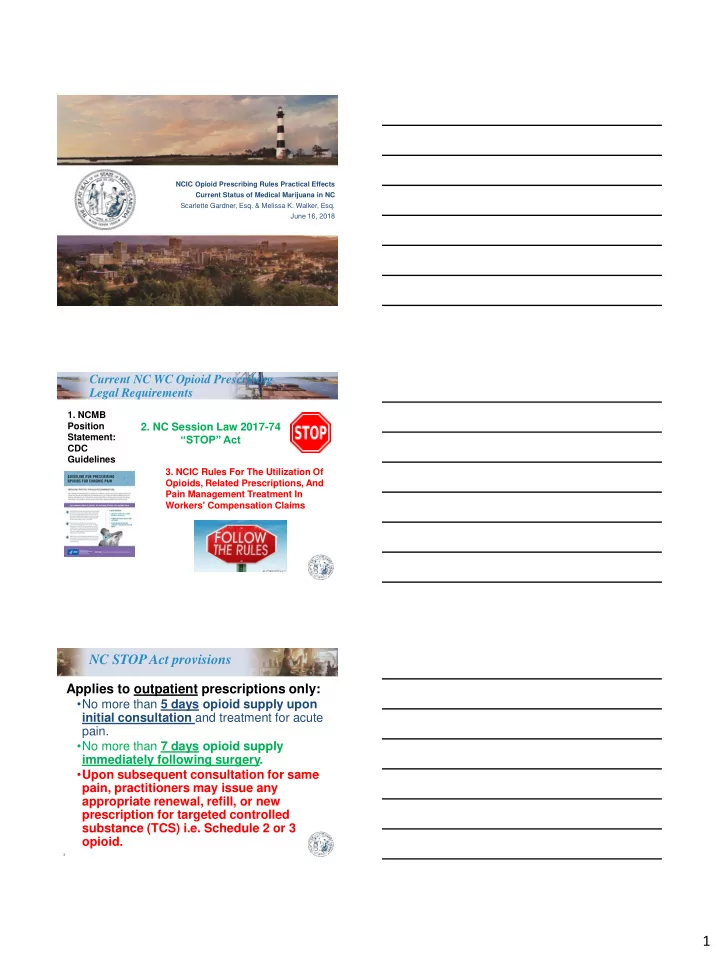
NCIC Opioid Prescribing Rules Practical Effects Current Status of Medical Marijuana in NC Scarlette Gardner, Esq. & Melissa K. Walker, Esq. June 16, 2018

Current NC WC Opioid Prescribing Legal Requirements

  • 2. NC Session Law 2017-74

“STOP” Act

  • 3. NCIC Rules For The Utilization Of

Opioids, Related Prescriptions, And Pain Management Treatment In Workers' Compensation Claims

  • 1. NCMB

Position Statement: CDC Guidelines

NC STOP Act provisions

Applies to outpatient prescriptions only:

  • No more than 5 days opioid supply upon

initial consultation and treatment for acute pain.

  • No more than 7 days opioid supply

immediately following surgery.

  • Upon subsequent consultation for same

pain, practitioners may issue any appropriate renewal, refill, or new prescription for targeted controlled substance (TCS) i.e. Schedule 2 or 3

  • pioid.

3

slide-2
SLIDE 2

2

4

NCIC Opioid Rules

Go to NCIC website at www.ic.nc.gov to obtain:

  • 1. Adopted

administrative rules

  • 2. NCIC Companion

Guide

  • 3. NCIC Chart: “Basics
  • f the phases of

treatment under the Opioid Utilization Rules (.200 Rules)

5

NCIC Opioid Task Force Guiding Principles

1. Attract and retain highly skilled medical providers for WC treatment. 2. Give prescribers a “legal” reason for refusal to continue opioid therapy. 3. INCENTIVIZE short-term opioid prescribing. 4. DETER long-term opioid prescribing via prescribing requirements and payer authorization discretion. 5. Promote non-pharmacological and non-opioid treatment alternatives for pain relief.

6

IMPORTANT NOTE!!!

  • No objection letters were filed with Rules

Review Commission.

  • Thus, Rules were not forwarded to General

Assembly for review which may have resulted in long delayed implementation and enactment of new laws disadvantageous to payers.

slide-3
SLIDE 3

3

7

NCIC’s Stated Purposes of Rules

  • 1. Rules DO NOT constitute medical advice or

standard of care.

  • 2. Rules address OUTPATIENT utilization of
  • pioids, related prescriptions, and pain

management treatment for non-cancer pain.

  • 3. Rules help ensure employees receive medical

care intended by Chapter 97 and costs are contained.

8

Practical Effects of Rules

What this means for individual claims?

  • 1. Rules create:
  • a. Reasonable prescriber hassle factor.
  • b. Sufficient payer authorization roadblocks to

slow down opioid therapy.

  • 2. Rules allow payer flexibility:
  • a. Payers may “pump the brakes” by refusing
  • pioid authorization when prescribers do

not adhere to Rules requirements.

  • b. Payers may authorize opioid therapy outside

Rules when they deem appopriate.

9

Applicability of Rules

  • Rules DO NOT APPLY to prescriptions issued

by non-workers’ compensation prescribers.

  • Workers’ compensation patients may be

prescribed anything by other prescribers simultaneously treating them.

slide-4
SLIDE 4

4

10

Applicability of .200 Rules

Date of first TCS prescription

(Targeted Controlled Substance - Schedule 2 or 3 opioid)

MUST BE May 2, 2018 or after for .200 Rules to apply.

11

Applicability of .200 Rules

EXEMPTION: WC patients who received TCS treatment more than 12 consecutive weeks immediately before May 1, 2018 i.e. first TCS prescription on or before February 5, 2018.

12

.200 Rules - 2 Pain “Phases”

Acute Phase: 12 weeks of treatment for pain following an injury by accident, occupational disease, surgery for an injury, or subsequent aggravation of an injury. There may be multiple “acute phases” during a claim. Chronic Phase: Continued treatment for pain immediately following a 12 week period of treatment using a targeted controlled substance “TCS”.

DIFFERENT RULES APPLY TO TCS PRESCRIPTIONS IN EACH PHASE.

slide-5
SLIDE 5

5

13

Applicability of .300, .400, .500 Rules

.300, .400, .500 Rules apply to ALL TCS prescriptions:

  • 1. Co-prescribing naloxone.
  • 2. Referral for non-pharmacological

treatment.

  • 3. Referral for opioid tapering/

substance abuse disorder assessment/treatment.

14

What is the role of Nurse Case Managers?

  • Nurse case managers may provide

general, non patient specific information to medical providers regarding existence and content of the Rules.

  • Nurse case managers may give medical

providers and employees documents published on NCIC website: ic.nc.gov

  • Nurse case managers may not provide
  • pinions to medical providers regarding

whether TCS treatment does or does not comply with the Rules.

  • Nurse may give notice to prescriber and

employee of potential issues with payer authorization of prescription.

15

Payer Options

REMEMBER: Rules address prescribing requirements for medical providers, not payers.

  • Payers may or may not

authorize TCS prescriptions that do not meet the Rules’ prescribing requirements.

  • Payers requiring adherence to

all Rules provides ability to put the brakes on TCS treatment.

slide-6
SLIDE 6

6

16

Payer Options

Payer Prescription Denial Options

  • Payer may immediately

authorize retail pharmacy dispensing of dosages up to the Rules’ limits so that patient goes home with some pain relief medication.

  • Payer may authorize

treatment outside of Rules based on medical documentation and communication with prescriber.

17

Payer Options

Other Payer Options To Combat Noncompliant Opioid Prescribing

  • Request written “medication

review” i.e. a peer review of all WC related medications prescribed by all authorized treating physicians.

  • Exercise NCGS §97-25 right to

direct medical treatment elsewhere i.e. change authorized treating physicians if unhappy with prescriber’s nonadherence to the Rules.

18

What happens if a payer refuses to authorize a prescription?

IMPORTANT POINTS!!!

  • Medical providers will

ALWAYS get paid for services rendered.

  • Payers MAY NOT

refuse to pay for a medical visit/treatment if medical provider writes a prescription that is not authorized by payer.

slide-7
SLIDE 7

7

19

What happens if a payer refuses to authorize a prescription?

Parties are encouraged to request information, communicate in detail, and reach agreement on an alternate course of treatment.

IF THAT DOES NOT WORK....

20

What if employee files a medical motion related to the Rules?

Rules allow employee to file NCGS §97-25 medical motion if disputes cannot be resolved by the parties: NCIC will rule based upon the following factors: (1) The necessity of a waiver; (2) The party's responsibility for the conditions creating the need for a waiver; (3) The party's prior requests for a waiver; (4) The precedential value of such a waiver; (5) Notice to and opposition by the opposing parties; and (6) The harm to the party if the waiver is not granted.

2 prongs of evidence supporting opioid therapy denial

Legal Arguments

  • TCS prescription exceeds MED limit.
  • Medical records fail to show prescriber

compliance with .200 Rules:

  • a. Periodic urinary drug testing (UDT).
  • b. Use of Opioid Risk Assessment Tool.
  • c. No documentation of NC CSRS checks

(effective 11/1/2018 or sooner).

  • d. No documentation non-opioid, non-

pharmacological therapy is not appropriate.

  • e. Type/number of TCS (short and long-acting).
  • Payer has attempted to compromise with

patient regarding pain treatment.

21

slide-8
SLIDE 8

8

22

2 prongs of evidence supporting opioid therapy denial

Patient Safety & Well-Being Arguments

  • Non-opioid meds or therapies have not been tried.
  • Long-term opioid therapy has not improved function.
  • Overall pharmacy risk due to potential interaction

with other drugs.

  • Limited or no objective physical findings supporting

subjective pain reports.

  • History of opioid overdose/naloxone use.
  • Prior attempt(s) to change authorized treating

physician (ATP) were rejected.

  • Prior attempt(s) to obtain medication review were

rejected or results ignored.

23

Important Legal Distinction!!!

  • Chronic pain is not a separate injury/

condition that must be accepted or denied, it is merely treatment for already accepted body parts/conditions.

  • Chronic pain treatment with any provider

type does not create a presumption that a separate mental injury/condition exists.

24

Cost Containment/Risk Management Strategies

  • 1. Advise payers to require PBM implement NC STOP Act

and Rules requirements in prescription approval algorithms.

  • 2. Advise payers to get list of claims with >90 MED scores

and closely monitor their medical records for prescriber compliance with Rules.

  • 3. Advise payers to direct or transfer care to physicians

that comply with Rules (especially pain management) and try other pain therapies before opioids.

  • 4. Advise payers authorizing non-pharmacological

treatment in lieu of opioid therapy to initially authorize same amount of visits as usual for such therapies to avoid potential medical motions.

slide-9
SLIDE 9

9

25

Cost Containment/Risk Management Strategies

  • 5. Advise payers to BE FLEXIBLE and make good faith

effort to confer with employee/counsel and prescriber to reach agreement on opioid therapy or alternatives instead of automatic denial.

  • 6. Advise payers to thoroughly document all efforts to

reduce opioid therapy to safe levels i.e. attempted/ completed medication reviews, communications with prescriber pursuant to NCGS §97-25.6(c)(2)(b), appropriate course of treatment.

  • 7. Utilize nurse case management services to closely

monitor and coordinate care for > 90 MED claimants, especially with multiple physicians prescribing opioids.

26

Cost Containment/Risk Management Strategies

  • 8. Advise payers to add more providers to PPO networks

to handle potential increased demand due to Rules:

  • a. Physical therapy/dry needling/massage
  • b. Acupuncture
  • c. Chiropractors
  • d. Cognitive Behavioral Therapists experienced in

chronic pain management

  • e. Pain Rehabilitation/Functional Restoration

Programs

  • f. Opioid tapering/weaning specialists
  • g. Opioid dependency/addiction treatment
  • h. IME physicians to address whether opioids

prescribed by WC provider(s) created dependency in need of tapering/weaning/addiction treatment

27

NCIC Opioid Rules Details 11 NCAC Chapter 23M NCIC Rules for the Utilization of Opioids, Related Prescriptions, and Pain Management Treatment in Workers’ Compensation Claims

slide-10
SLIDE 10

10

28

“Acute Phase” Prescriptions What a prescriber CANNOT do in any “Acute Phase” prescription:

  • 1. NO Fentanyl.
  • 2. NO transcutaneous, transdermal,

transmucosal, or buccal opioid preparations without documentation in the medical record that oral opioid dosing is medically contraindicated.

  • 3. NO benzodiazepines for pain or as muscle

relaxers.

  • 4. NO Carisoprodol and a TCS in an acute phase.
  • 5. NO prescription given to patient in advance to

be dispensed at a later date.

29

“Acute Phase” - First Prescription

PRESCRIBING REQUIREMENTS: ❑ Document non-pharmacological and non-opioid treatment is insufficient. ❑ Review information in CSRS regarding patient for preceding 12 months (effective 11/1/18). ❑ Shortest duration necessary: no more than 7 day supply post-surgery; no more than 5 day supply for anything else. ❑ Lowest effective dose not to exceed 50 MED/day. (Exception: Patient taking 50 MED/day before surgery). ❑ Only one short-acting TCS.

30

“Acute Phase” – Next Prescription after Days 5-7

s

PRESCRIBING REQUIREMENTS: ❑ Document non-pharmacological and non-opioid treatment is insufficient. ❑ Review information in CSRS regarding patient for preceding 12 months (effective 11/1/18). ❑ Shortest duration necessary not to exceed one 30- day supply at a time. ❑ Lowest effective dose not to exceed 50 MED/day. Exception: up to 90 MED/day with documentation of medical justification. ❑ Only one short-acting opioid.

slide-11
SLIDE 11

11

31

“Acute Phase” – Days 35-37 through Day 84 PRESCRIBING REQUIREMENTS: ❑ Document non-pharmacological and non-opioid treatment is insufficient. ❑ Review information in CSRS regarding patient for preceding 12 months (effective 11/1/18). ❑ Shortest duration necessary not to exceed one 30- day supply at a time. ❑ Lowest effective dose not to exceed 50 MED/day. Exception: up to 90 MED/day with documentation

  • f medical justification.

❑ Only one short-acting opioid.

32

“Acute Phase” Days 35-37 through Day 84

AND THERE’S MORE…. May continue ongoing treatment with TCS in ACUTE phase

  • nly if:
  • 1. Urine Drug Testing (UDT):
  • a. Administer presumptive urine drug test (UDT).
  • b. If presumptive UDT shows nondisclosed illicit or

controlled substance(s) or does not show prescribed TCS, order confirmatory UDT.

  • 2. Administer clinically validated opioid risk tool to assess risk
  • f opioid-related harm.
  • 3. Document in medical record whether CSRS review,

UDT, or risk tool indicates increased risk of opioid-related

  • harm. If opioid treatment is continued where

there is increased risk, document medical justification..

33

“Chronic Phase” Prescriptions

What a prescriber CANNOT do in any “Chronic Phase” prescription: 1. NO transcutaneous, transdermal, transmucosal, or buccal opioid preparations without documentation in the medical record that oral opioid dosing is medically contraindicated. 2. NO benzodiazepines for pain or as muscle relaxers. Benzodiazepines are man-made medications that cause mild to severe depression of the nerves within the brain (central nervous system) and sedation (drowsiness). Benzodiazepene examples: Xanax, Klonopin, Valium (diazepam), Ativan (lorazepam), Halcion (triazolam)

slide-12
SLIDE 12

12

34

“Chronic Phase” prescriptions - after 12 consecutive weeks of treatment) PRESCRIBING REQUIREMENTS:

❑ Document non-pharmacological and non-opioid treatment is insufficient. ❑ Review information in CSRS regarding patient at every appointment when TCS is prescribed or every 3 months, whichever is more frequent. (effective 11/1/18). ❑ No more than two opioids at a time – one short-acting TCS and one long-acting TCS. ❑ Shortest duration necessary not to exceed one 30 day supply at a time.

35

“Chronic Phase” prescriptions - after 12 consecutive weeks of treatment)

AND THERE’S MORE… ❑ Lowest effective dose not to exceed 50 MED/day. Exception: up to 90 MED/day with documentation

  • f medical justification.

Exception: up to 120 MED/day with documentation of medical justification and payer preauthorization. ❑ Must have payer preauthorization for: transdermal fentanyl, methadone for pain, carisoprodol combined with a TCS.

36

“Chronic Phase” prescriptions - after 12 consecutive weeks of treatment

AND THERE’S MORE…. May continue ongoing treatment with TCS in CHRONIC phase only if:

  • 1. Urine Drug Testing (UDT):
  • a. Administer presumptive urine drug test (UDT): minimum

2 times and maximum 4 times per year without payer preauthorization (may be random and unannounced)

  • b. If presumptive UDT shows nondisclosed illicit or

controlled substance(s) or does not show prescribed TCS,

  • rder confirmatory UDT (may prescribe limited supply of

TCS while awaiting results)

  • c. Additional UDT may be ordered for documented medical

reasons.

slide-13
SLIDE 13

13

37

“Chronic Phase” prescriptions - after 12 consecutive weeks of treatment

AND THERE’S MORE…. May continue ongoing treatment with TCS in CHRONIC phase only if:

  • 2. Document in medical

record whether CSRS review, UDT, or risk tool indicates increased risk of opioid- related harm. If opioid treatment is continued where there is increased risk, document medical justification for prescribing TCS.

38

“Chronic phase” prescriptions - after 12 consecutive weeks of treatment OTHER SPECIAL CONSIDERATIONS:

  • 1. Whenever a different provider begins treating WC patient with

TCS, that provider must administer clinically validated opioid risk assessment tool.

  • 2. If patient is receiving carisoprodol or benzodiazepines from

another prescriber, then WC medical provider who adds opioid must inform other provider he has done so and advise employee

  • f risk of taking such medications with an opioid.

39

Does employee need an opioid antagonist (naloxone/Narcan)?

Provider shall consider prescribing opioid antagonist during “acute” or “chronic” phase if:

  • 1. Patient takes a benzodiazepine or carisoprodol and an
  • pioid.
  • 2. Patient takes more than 50 MED/day.
  • 3. Patient has history of drug overdose.
  • 4. Patient has history of substance abuse disorder.
  • 5. Provider is aware patient has underlying mental health

condition that poses increased risk of overdose.

  • 6. Patient has medical condition or co-morbidity that poses

increased risk of overdose.

slide-14
SLIDE 14

14

40

Does employee need an opioid antagonist (naloxone/Narcan)?

  • Prescription shall be written to allow product

selection by payer to include FDA-approved intranasal formulation.

  • Payers ARE NOT required to pay for an opioid

antagonist every time an opioid is prescribed…they are good for several years.

  • Approximate retail cost two-pack: $130.00

41

How to order nonpharmacological treatment?

  • Provider may order nonpharmacological treatment

i.e. acupuncture, physical therapy, chiropractic massage therapy, biofeedback, cognitive behavior therapy, functional restoration programs, etc. just like you order anything else.

  • Payer may request additional information from

provider via any method allowed by the WC Act. (NCIC has created non-mandatory form.)

42

How to order evaluation for need to taper opioids or addiction?

  • Provider may refer patient to appropriate provider

for evaluation for opioid taper or addiction.

  • Payer may request additional information from

provider via any method allowed by WC Act. (NCIC has created non-mandatory form.)

slide-15
SLIDE 15

15

43

Typical Workers’ Compensation Pain Cycle

Traditional pain management approach: Step 1: Prescribe drugs/procedures Step 2: If pain does not subside or worsens, repeat Step 1. Why: Fastest, cheapest route to close claim. WHAT HAS BEEN IGNORED? Biopsychosocial factors

44

Biopsychosocial Factors

Potential Biospsychosocial Factors ▪Lifestyle factors (e.g., diet, exercise, sleep) ▪Stressors and stress management strategies ▪Psychosocial context (e.g., family constellation, family medical/psychological, impact of illness on family) ▪Recent major life events ▪Perceived strengths ▪Job/academic activities ▪Hobbies ▪Peer supports ▪Meaning of illness ▪Functional impairment (what patient can or cannot do) ▪Cultural factors (e.g., meaning of illness, preferred treatment approaches, involvement of elders and religious leaders)

Change the Pain Paradigm

Change the chronic pain treatment cycle: Step 1: Assess and diagnose biopsychosocial factors driving pain early in claim and provide needed behavioral health interventions ranging from simple to complex. Step 2: Prescribe appropriate non-opioid therapies first and give them time to work. Examples: biofeedback, cognitive behavior therapy, dry needling, acupuncture, chiropractic, physical therapy, etc. Step 3: Use opioids as a last resort for long term pain.

45

slide-16
SLIDE 16

16

Contact Information: Scarlette Gardner, Esq.

NC Office of State Human Resources State Workers’ Compensation Manager 116 West Jones Street Raleigh, NC 27603

(919) 807-4858 scarlette.gardner@nc.gov OSHR Website: workerscomp.nc.gov

46